Honey Wheat Bread Recipe
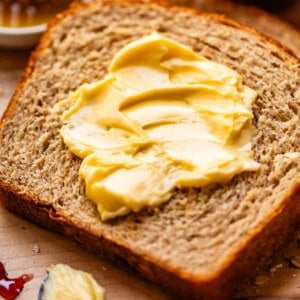
HALLELUJAH! I have finally found the secret to whole wheat bread that is SOFT and FLUFFY! It is bouncy, tender, rises higher than a kite, and is super easy to make. This whole wheat bread is sweet with a touch of honey flavor, plenty of salt so that it doesn't taste flat, and a secret ingredient that keeps the crust soft for days. Perfect for sandwiches, toast, or the best PB&J of your life!
Servings: 15
Calories: 175kcal
Equipment
- instant read thermometer
Ingredients
For the sponge:
- 1 cup warm water
- 2 tablespoons vital wheat gluten
- 3 tablespoons honey
- 1 cup whole wheat flour spooned and leveled (113 grams)
In a small bowl:
- 2 tablespoons warm water 105-110 degrees F
- 1 tablespoon active dry yeast
- 1 teaspoon granulated sugar
For the dough:
- 3 tablespoons granulated sugar
- 1 tablespoon Diamond Crystal Kosher salt** not a typo. (Use 2 teaspoons if table salt is all you have.)
- 3 tablespoons shortening*** I like butter flavored shortening
- 2 tablespoons mashed russet potatoes freshly boiled and mashed, no seasonings
- 1 cup whole wheat flour spooned and leveled (113 grams)
- 1 cup bread flour spooned and leveled (113 grams)
- up to 1/2 cup bread flour spooned and leveled (57 grams)
- 1 tablespoon oil for greasing the bowl and bread pan
- butter for rubbing on the baked bread
Instructions
- Make the sponge: In a large bowl or stand mixer, add 1 cup of warm water, 2 tablespoons vital wheat gluten, 3 tablespoons honey, and 1 cup of whole wheat flour, spooned and leveled (or 113 grams). Whisk thoroughly, cover, and let rest for 30 minutes. Set a timer!*
- Boil the potatoes: While you let the sponge soften the wheat bran, boil your potatoes. Peel 1 small russet potato. Cut into even chunks. Add to a small pot and cover with water. Bring to a boil over high heat. Lower the heat to a simmer and let cook for 10-15 minutes, until the potato easily falls apart when you poke it with a fork.
- Remove a few of the potato pieces to a plate. Mash the potato with a fork. Do a very thorough job! If you have a colander or strainer of some kind, force the potato through it to make the potato as fine as possible. (A potato ricer is best, but who has one of those??) If you don't have anything, just do your best with the fork. Set aside.
- Proof the yeast: When the 30 minutes for the sponge is up, proof the yeast. Add 1 tablespoon yeast to a small bowl. Add 2 tablespoons warm water (105-110 degrees F, warm tap water is perfect) and 1 teaspoon granulated sugar. Stir it together and let it sit for about 5 minutes until it bubbles.
- Meanwhile, add the rest of the ingredients to the sponge. Add 3 tablespoons granulated sugar, 1 tablespoons Diamond Crystal Kosher Salt,** 3 tablespoons shortening,*** and 2 tablespoons finely mashed potato.
- Add the bubbly yeast mixture to the sponge.
- Add 1 cup whole wheat flour, spooned and leveled (113 grams), to the bowl. Stir it together with a rubber spatula.
- Add 1 cup bread flour, spooned and leveled (113 grams), to the bowl. Use a sturdy wooden spoon to stir it in, or use the dough hook on your machine to stir it in.
- Knead the dough (either by hand or using the dough hook) for 10 solid minutes. Set a timer and don't fudge on this. Wheat bread needs a LOT of kneading to develop the gluten it needs to rise properly.
- As you knead for 10 minutes, gradually add another 1/2 cup of bread flour, spooned and leveled (about 57 grams). You don't need to add the full amount if your dough does not need it. By the end of kneading, you are looking for the dough to be able to stretch without breaking. It should be smooth and elastic. It should be a little sticky, but cleaning the sides of the bowl. If you are new to bread making and using a stand mixer, it's helpful to flour a surface and knead the dough by hand a few times, just to get the feel of it. If it's sticking to the counter a lot, add a tablespoon more flour at a time. If the dough feels hard and not supple, don't add more flour, just keep kneading a while longer.
- Coat a large bowl with about 1/2 tablespoon oil. Use your hands to rub it all the way up the sides. Shape your kneaded dough into a ball and place it in the bowl. Turn it over so the top has oil on it. Cover the bowl with plastic wrap that you have sprayed with nonstick spray, or rubbed with oil.
- Turn your oven on to 350 degrees for about 1 minute. Set a timer! Turn the oven off right away. Your oven should be about 100 degrees inside. It should feel pleasantly warm. You should still be able to touch the racks with your fingers with no problem. Place the covered bowl in the oven and let rise for 2 to 2 and 1/2 hours. The risen dough should be doubled in size.
- Coat the bottom and sides of a 9x5 inch loaf pan with 1/2 tablespoon oil. Rub it all around, even the upper edges that flatten out.
- Uncover the dough (save the plastic wrap.) Turn the dough onto a lightly floured work surface (use bread flour). Use your hands to knead the dough 5-10 times.
- Use your hands to press the dough into a rectangle that is a little shorter than the length of your loaf pan. Press your fingers into the dough from the center working outward, specifically looking for any air pockets. (These air pockets will make big giant holes in your bread which we don't want.) Keep the rectangle the length of the pan, and the other side of the rectangle can be as long as you need it to be to get rid of air pockets.
- Once the dough is air pocket free, flip the rectangle over, if the top of the dough is smoother than the bottom. (You want to roll smooth side out, so your loaf is nice with no marks.)
- Start rolling from the end that is the length of the loaf pan. Slightly pinch the dough as you roll it up (see photos) to avoid air pockets.
- Once it's rolled up, make sure the seam is on the bottom. (I never bother sealing it, the weight of the bread keeps it together.) Use your fingers to round out each end of the loaf, where you might see the rolled edges. Use your fingers to fold it underneath and pinch a bit. See photos.
- Carefully transfer your baby loaf (it's progeny, at this point) into the greased loaf pan. Tuck the ends in and straighten it out.
- Cover the loaf with the greased plastic wrap, adding more oil to the plastic as necessary. You don't want the plastic sticking, it will ruin your rise!
- Let the bread rise in a warm place for about 30-40 minutes. 10 minutes into your rise time, turn your oven on to 375 degrees so your oven has time to get REALLY hot. Watch your bread carefully at this point: over proofed dough will collapse when it hits the oven. You want your dough to rise about 1 and 1/2 inches above the edge of the pan.
- When your dough has risen, remove the plastic wrap carefully. Gently pick up the loaf pan and move it to the oven. Don't bang it around too much! You don't want it to fall.
- Bake at 375 degrees F for 10 minutes.
- Lower the heat to 350 degrees F.
- Get a large rectangle of tin foil. Use your fingers to gently scrunch up the foil a bit, so that it is still flat but holds its shape without flopping around so much. Shape the foil into a tent, dull side down.
- Open the oven door and place the foil, dull side down toward the bread, over the top of the bread. Try not to touch the bread too much.
- Close the door. Remember to lower the heat to 350 degrees.
- Bake at 350 degrees for 20-25 minutes, until an instant read thermometer inserted into the center of the bread reads 205-210 degrees F. The top of the bread should be browned. The edges of the bread should have pulled away from the edge of the pan. The best way to know is with the thermometer. I don't make bread without it.
- Remove the bread from the oven and place on a wire cooling rack. Within 2 minutes, use hot pads to turn the loaf on its side and release the bread from the pan. (You don't want the crust getting soggy.)
- Cool the bread on its side, so the rounded part is on the side. This will help the top-heavy bread from crushing itself with its own weight. We want to keep that nice tall rise we fought so hard for!!
- Brush all the sides of the bread with a stick of butter. Yes, even the sides and bottom! This will help the crust stay soft for days.
- Let cool completely. I know, this is tough. Wait at least a half hour, if you can't wait until it's completely cool. If you try to slice hot bread, it will just crush it, and ruin your rise.
- Use the sharpest serrated knife that you have to slice the bread.
- Toast. Top with obscene amounts of butter. Drown in jam. Or sprinkle with enough cinnamon sugar that the top layer of sugar stays visible, in granules. Live. your. best. life!!!! Or, use the soft bread to make the most amazing PB&J of your life. Or a dagwood sandwich with all the fixins. Yummm guys it's so good!!
Notes
*SPONGE TIME: It's totally okay to let your sponge rest for longer than 30 minutes. You can let it rest for up to 2-3 hours. Much longer than that, and your liquid will start to evaporate, so I don't recommend going longer. Make sure it's tightly sealed if you plan to let it sit for a couple hours.
**KOSHER SALT: If you don't have Diamond Crystal Kosher Salt, order some right away for the next time you make literally anything ;) But also you can just use 2 teaspoons table salt, or 2 and 1/2 teaspoons if you are brave.
***SHORTENING: Many recipes call for oil instead of shortening. I prefer shortening because it's 100% fat, but it's solid at room temperature. Replacing it with butter will work, but your bread won't be as soft. (Butter is only 80% fat.) Oil is 100% fat. You can replace the shortening with oil, but you will need to use more bread flour for your dough to form, diluting the flavor of your bread.
DOUBLING: You can double this recipe and bake in 2 9x5 inch pans. I would separate the dough before the first rise. Knead for a gooood long while, and only use a stand mixer if it's super powerful!
Nutrition
Calories: 175kcal | Carbohydrates: 30g | Protein: 5g | Fat: 4g | Saturated Fat: 1g | Polyunsaturated Fat: 1g | Monounsaturated Fat: 2g | Trans Fat: 0.3g | Potassium: 89mg | Fiber: 2g | Sugar: 6g | Vitamin A: 2IU | Vitamin C: 0.4mg | Calcium: 11mg | Iron: 1mg
