Pecan Pralines
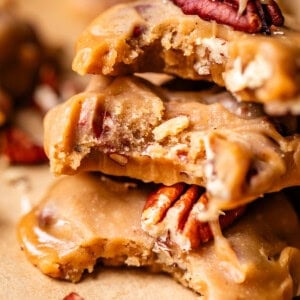
Pecan pralines are a buttery, caramel-y, melt-in-your-mouth cookie. Or is it candy? It's kind of both! The recipe consists of toasted, crunchy pecans in a dreamy cloud of brown sugar, caramel-y, creamy, fudgy candy, dropped into the shape of a cookie. They are a New Orleans classic, and I am obsessed. You only need a few easy ingredients to make them! Follow my step-by-step guide for your new favorite Christmas neighbor treat!
Servings: 30
Calories: 165kcal
Ingredients
- 4 tablespoons butter
- 1 cup heavy cream
- 1 and 1/2 cups brown sugar packed
- 1 and 1/4 cups granulated sugar
- 2 tablespoons corn syrup
- 3 tablespoons fresh lemon juice
- 1/2 teaspoon kosher salt
- 1 teaspoon baking soda sifted
- 1 teaspoon vanilla extract
- 2 cups pecans TOASTED, please for the love
Instructions
- Toast your pecans. Preheat the oven to 350 degrees F.* Add 2 cups pecan halves to a rimmed baking sheet and spread out into a single layer. Toast in the oven for about 5 minutes, then stir. Continue stirring every 2 minutes until the pecans are very fragrant. When you see the tips of some of them turning dark brown, they are toasted. Remove from the oven and set aside to cool.
- Prepare your pans. Line 2 half baking sheets with parchment paper and set aside.
- Butter the pot: Set a HEAVY bottomed 3-quart pot on the stove over medium-low heat. Add 4 tablespoons butter to the pot and use a wooden spoon to move the butter all around the edges toward the top of the pan, so all of the bottom and sides of the pot are greased with melting butter. (This will help your pralines not to crystallize.)
- Immediately add 1 cup heavy cream.**
- To the center of the pot, avoiding getting sugar granules on the side of the pot, add 1 and 1/2 cup packed brown sugar and 1 and 1/4 cups granulated sugar. Gently stir the mixture with a wooden spoon.
- Add 2 tablespoons corn syrup, 3 tablespoons fresh lemon juice, and 1/2 teaspoon kosher salt.
- Dissolve the sugar SLOWLY. Use your wooden spoon to stir the mixture together over medium low heat. Continue stirring occasionally for about 5 minutes. The goal right now is to get all the sugar to dissolve into the liquid BEFORE the mixture comes to a boil. You can move your heat up to medium if it's going really slow, but be careful. Do not let it come to a boil right away.
- Rub the mixture between your fingers: You will know it's ready to bring to a boil when you dip a finger into the mixture and rub it between two fingers. If it's completely smooth, all the sugar is dissolved. If you still feel anything grainy, those are sugar granules, and it's not ready yet. Keep cooking at about a medium-low heat.
- Bring to a boil. When you are sure the sugar is completely dissolved, move the heat up to medium and bring to a boil.
- Do not stir: Once you see bubbles coming up from the center of the pot, take your wooden spoon out and put it directly in the sink. Do NOT stir while the mixture boils; this can cause crystallization.
- Candy thermometer. Let the mixture boil for anywhere from 3-7 minutes (there are too many variables to rely on exact times unfortunately). It's time to bust out the candy thermometer. Set the thermometer on the side of the pan, making sure it's not touching the bottom, and watch it bubble until the temperature reaches 236 degrees.
- Remove from heat when the bubbling candy has reached 236 degrees. DO NOT STIR. Set the pot on a cooling rack away from the stove so it can start cooling.
- WAIT. This part is hard. Let your candy sit undisturbed for about 20-40 minutes. (The amount of time will depend on the temperature of the house) Use your candy thermometer to check the temperature occasionally. When the candy cools down to about 115 degrees F, it's go time.
- When your candy has cooled to 115 degrees F, use a brand new clean wooden spoon to add in the next ingredients: 1 teaspoon SIFTED baking soda (to avoid clumps) and 1 teaspoon vanilla extract.
- Stir the mixture for 2 minutes: NOW, finally it's time to stir. You can't skip this step, or the pralines will never set up. Beat the baking soda and vanilla into the mixture. Even though it's off the stove now, you will see the baking soda work it's magic. The mixture will bubble and froth a bit. This is how we get CREAMY pralines.
- Add 2 cups pecans. Add 2 cups of toasted pecan halves and stir them into the candy.
- Keep your thermometer in the candy. Keep stirring. When the candy has reached about 105-110 degrees F, it's time to start testing them on the cookie sheet.
- Test: Drop a small teaspoon of the candy (without any nuts) onto a parchment paper lined pan. If it is shiny and glossy even after dropping it, it's too early. Keep stirring. See photos.
- When you drop a teaspoon of candy and it starts to look opaque, that's when you know the candy is ready to drop. The candy should look fudgy and creamy, not glossy, shiny, or pool-like. It should have rounded edges that look plump at the top edge, and not instantly flatten out like liquid spreading.
- GET MOVING. Now that your candy is at the perfect temperature for dropping, MOVE FAST. You have a very limited amount of time before they start to get TOO cool for dropping.
- Drop the pralines. Use a spoon, or I like to use this exact 1 and 3/4 inch cookie scoop, to drop the pralines on the prepared sheet, with space in between so they don't run into each other.
- If you notice that the pralines you have dropped are looking too glossy and shiny, stop dropping and start stirring the pot again. If you drop them before they are opaque, they will NOT set up. They will be too soft to hold their shape.
- Continue dropping the pralines until all the candy is shaped. You will get about 27-30 pralines, depending on how big you make them.
- Let cool completely. Let the pralines cool on the pan at room temperature until they are easily lifted off the pan with a spatula without bending, at least 20-30 minutes.
- Store pralines tightly sealed on the countertop. Do not refrigerate, it will just dry them out faster. I keep mine in a tupperware, but if you really want them to last, wrap each praline individually in plastic.
- Freezing: Pralines freeze well! They are a great make ahead option. Wrap each praline individually in plastic wrap. Place all the wrapped candies into a freezer ziplock bag, remove as much air as possible, and seal. This way the pralines won't stick to each other and they will maintain their soft and chewy texture. They will be best when used within 2-4 weeks, but can stay frozen for up to 2 months.
- To serve after freezing, make sure any candies are not directly touching each other so they don't stick, keep them covered, and let them sit out on the counter for 2-3 hours until soft.
Notes
*Toasting pecans: You can also toast pecans on the stove top in a dry pan, if you like. Heat over medium and stir constantly until the nuts are turning brown and are fragrant. Stovetop toasting is not as even, so I prefer to use the oven. (this also might be because I walk away from the stove and forget about my toasting nuts half the time...)
**Heavy cream: Heavy cream is sold near the milk in the dairy section. It is not coffee creamer. Sometimes it is labeled whipping cream, ultra heavy whipping cream, etc. These names differentiate fat content levels. Any type of cream will do for this recipe. (The higher the fat content, the richer your candy will be)
**Heavy cream substitutes: You can use 1 cup evaporated milk in place of the heavy cream!
Nutrition
Calories: 165kcal | Carbohydrates: 21g | Protein: 1g | Fat: 9g | Saturated Fat: 3g | Polyunsaturated Fat: 2g | Monounsaturated Fat: 4g | Trans Fat: 0.1g | Cholesterol: 13mg | Potassium: 52mg | Fiber: 1g | Sugar: 21g | Vitamin A: 167IU | Vitamin C: 1mg | Calcium: 20mg | Iron: 0.3mg
